

Red Dot Foundation unveils a four-kilometre “living petition” urging reform of Indian Penal Code!
#RedDotFoundation unveils a four-kilometre “living petition” urging reform of Indian Penal Code to protect married women from sexual violence
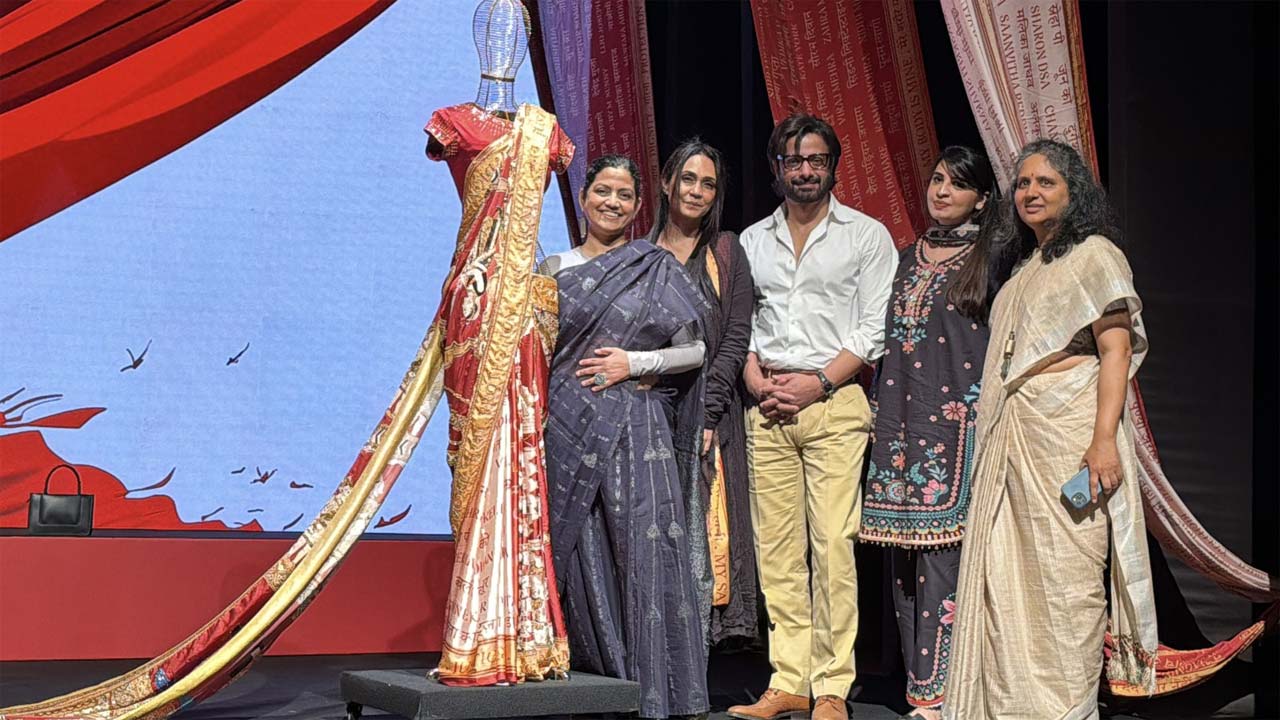
Mumbai, January 29, 2026: In a striking blend of art, activism, and advocacy, the Red Dot Foundation unveiled the Infinite Saree at Mumbai’s Royal Opera House—an installation that has already become a powerful emblem of women’s dignity and justice. The unveiling was led by filmmaker Supreet K. Singh, Co-founder and CEO of the UN-accredited nonprofit, and witnessed the coming together of policymakers, diplomats, activists, social media voices, survivors of domestic abuse, and supporters united by a single demand: the removal of the Marital Rape Exception from the Indian Penal Code.
Stretching an extraordinary four kilometres, the Infinite Saree holds the record for being the longest saree ever created. Conceptualised and designed by renowned fashion designer Nivedita Saboo, the saree functions as a “living petition,” featuring embroidered messages and custom prints, along with hundreds of signatures calling for justice and legal reform. The dramatic ombré couture creation is so vast that it could encircle the base of the Taj Mahal twice. Its inspiration draws from an ancient Indian legend in which a woman is saved from dishonour when her saree becomes endless—here reimagined as a symbol of protection, resistance, and resilience.
Speaking at the event, Supreet K. Singh emphasised the urgency behind the initiative. She noted that each signature stitched into the saree represents courage and the right of women to consent without fear. Highlighting the grim reality that married women form the largest group of sexual violence survivors in India, Singh pointed out that the law still fails to recognise non-consensual sex within marriage as rape. She stressed that consent cannot be conditional upon marital status and urged lawmakers to acknowledge marital rape unequivocally as a violation of a woman’s constitutional rights to safety, dignity, and bodily autonomy.
Designer Nivedita Saboo described the Infinite Saree as an effort to use culture itself as a tool for reform. She explained that while the saree has long symbolised Indian womanhood, it can also serve as a catalyst for progress and equality. For her, the project stands as proof that tradition and transformation need not be at odds, and that India’s most iconic garment can also become a contemporary symbol of justice.
Data from India’s National Family Health Survey (NFHS-5) and recent studies underline the scale of the issue. Nearly one-third of Indian women have experienced physical or sexual violence at the hands of their spouses. Around 18 percent of married women report being unable to refuse sex, while one in five men admit to reacting with anger if their wives do so.
Alarmingly, over 90 percent of women who face sexual violence never seek help or formally report the abuse.
Survivor and activist Zaaria Patni spoke about the strength of collective action, stating that when lawmakers, survivors, activists, and citizens stand together, change becomes inevitable. She called for marital rape to be addressed openly and no longer shielded by the institution of marriage.
The campaign comes at a crucial juncture in India’s legal discourse. Under current law, forced sex within marriage—if the wife is 18 years or older—is not categorised as rape. Although the Supreme Court criminalised sexual relations with a wife under 18 in 2017, the broader exception remains intact. Following a split verdict by the Delhi High Court in 2022, the Supreme Court consolidated several petitions and began hearings in 2024, later postponing further proceedings. In December 2025, Member of Parliament Dr. Shashi Tharoor described the marital rape exception as a grave injustice and introduced a private member’s Bill in the Lok Sabha seeking its removal, calling it a colonial-era provision that violates women’s fundamental rights.
Actor and campaign ambassador Rahul Bhat also lent his voice to the cause, observing that while many believe home to be the safest space, it is not so for countless women. He stressed that violence inflicted by a spouse is often the hardest reality to confront, especially when laws fail to offer adequate protection. Calling the issue deeply human rather than merely legal, he urged citizens to support the petition demanding change.
Following its debut at the Royal Opera House, the Infinite Saree will be exhibited at the Kala Ghoda Arts Festival 2026 at Elphinstone College, Mumbai, from January 31 to February 8. By placing the installation in a major cultural hub, the initiative aims to spark broader public dialogue around consent, marital rape, and women’s rights—framing legal reform as a social and constitutional necessity rather than a private concern.
As the matter remains under consideration by the Supreme Court of India, the Infinite Saree campaign seeks to sustain public engagement and strengthen legal advocacy ahead of future hearings. Through continued mobilisation of citizens and institutions alike, the Red Dot Foundation plans to keep the call for the removal of the marital rape exception firmly in the national conscience.
By Keerti Kadam