

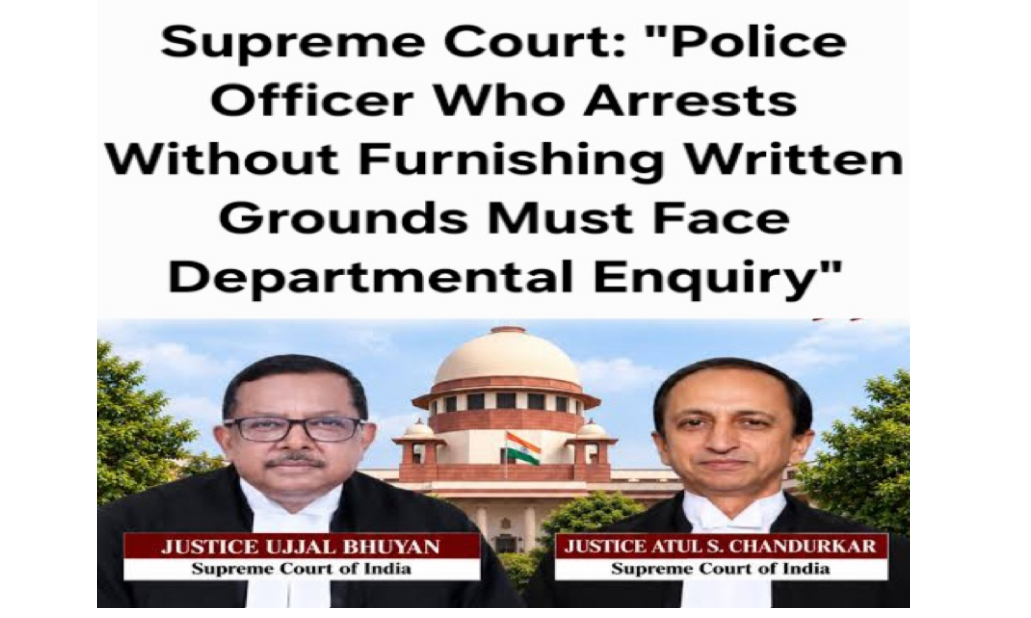
Supreme Court: “Police Officer Who Arrests Without Furnishing Written Grounds Must Face Departmental Enquiry”
By Ronnie Rodrigues
New Delhi, September 21: The Supreme Court has ruled that failure to provide an arrested person with written grounds of arrest can render the arrest unconstitutional and may also lead to departmental proceedings against the police officer responsible.
A Bench comprising Justice Ujjal Bhuyan and Justice Atul S. Chandurkar reiterated that informing an arrested person of the grounds of arrest in writing is a constitutional safeguard guaranteed under Article 22(1) of the Constitution. The Court made it clear that the requirement is not a mere procedural formality.
The judgment was delivered in the case concerning Jaskaran Jeet Singh v. State of Punjab, in which the Court declared the arrest of Jaskaranjit Singh illegal after finding that the grounds of arrest had not been furnished to him.
Written grounds must be supplied to the accused
The Court laid down that the grounds of arrest must be prepared in writing, in a language understood by the arrested person, and a copy must be supplied to the accused without exception and at the earliest opportunity.
The Bench emphasized that violation of this constitutional protection affects the legality of the arrest and remand. It further stated that an accused released because of such a violation is not being released on bail; rather, the person is being released from what the Court characterises as illegal and unconstitutional detention.
The Court also clarified that a subsequent filing of a chargesheet or an order taking cognisance of the offence cannot retrospectively validate an arrest that was unconstitutional because the grounds of arrest were not properly furnished. The protection under Article 22(1), according to the judgment, applies irrespective of whether the offence is under the general penal law or a special statute.
Re-arrest cannot be left solely to the same investigating officer
The Supreme Court also prescribed safeguards for cases where the investigating agency believes that further custodial interrogation is necessary after an accused has been released following an illegal arrest.
According to the Court’s directions, the investigating agency must first furnish the grounds of arrest and then approach the concerned Magistrate with an application explaining the necessity for re-arrest and custody. The application must also explain why the grounds of arrest were not supplied initially.
The Court directed that such an application should carry the endorsement of the immediate superior authority. The Magistrate is required to consider the request expeditiously and decide whether re-arrest is warranted.
Departmental inquiry against the erring officer
The judgment also places an administrative responsibility on the police hierarchy.
Where an officer has failed to comply with the constitutional requirement, the superior authority is required to assign further investigation to another officer and direct a departmental inquiry into the lapse. If the inquiry results in adverse findings, the Court said departmental action should follow and the adverse action should be reflected in the officer’s service record.
Constitutional safeguards cannot be diluted
The Bench further reiterated that constitutional protections concerning personal liberty must be strictly followed. It referred to the long-standing requirement that a person arrested must be produced before a Magistrate within 24 hours and stressed that constitutional safeguards cannot be diluted because of the nature or seriousness of the alleged offence.
On the administrative side, when the superior authority is presented with an application taking an endorsement for the custody of the accused who has been released for violation of Article 22(1), he shall hand over the investigation of the case to another officer, further directing department inquiry for such a serious lapse. If the inquiry culminates in adverse findings against the police officer, it would entail departmental action with entry in the service book of the officer.
After pronouncing the procedural safeguards, the Court concluded, saying: “Long back in the celebrated case of Khatri, the Court had strongly urged that the constitutional requirement to produce a person before a judicial magistrate within 24 hours of arrest must be strictly and scrupulously observed. We have come a long way since then but this constitutional mandate continues to remain firm and unshaken as if engraved in stone. Similarly to what we have held and directed, same procedure has to be follwoed when there is a breach of clause (2) of Article 22 of the Constitution of India and if the investigating agency still wants the custody of the accused, after his release from such constitutional violations.
Additionally depending upon the facts and circumstances, the High Courts may direct payment of compensation as a part of public law remedy in case of violation of Article 22(2) of the Constitution with liberty to the accused to avail the remedy under private Civil Law. Before we wind up, we must remind ourselves that constitutional provisions can’t be interpreted in a vacuum. Constitution is based on certain principles much above the statutory threshold.
Therefore, violation of the Constitution or the constitutional provisions can’t be countenanced. It has to be dealt with strictly. It is not dependent on the nature or gravity of the offence, and it can’t be interpreted in a restrictive manner. Though observed in the backdrop of preventive detention, it is nevertheless worth mentioning and reiterating for a three-judge of this Court in Prabhu Dayal Deorah v. The District Magistrate, Kamrup (1974), this Court observed: ‘The gravity of the evil to the community resulting from anti-social activities can never furnish an adequate reason for invading the personal liberty of a citizen, except in accordance with the procedure established by the Constitution and the laws…Therefore, whatever its impact on the maintenance of supplies and service,essential to the community may be, when a certain procedure is prescribed by the Constitution or the laws for depriving a citizen of his liberty, it is the duty, of the Court to see that the procedure is rigorously observed.”
The Court also observed that, depending on the circumstances, High Courts may award compensation as a public-law remedy where constitutional safeguards relating to detention have been violated.
The Supreme Court’s directions were ordered to be communicated to the Directors General of Police of all States and Union Territories, underscoring the administrative significance of the ruling.
Case: Jaskaran Jeet Singh v. State of Punjab, Criminal Appeal No. 4234/2026.