

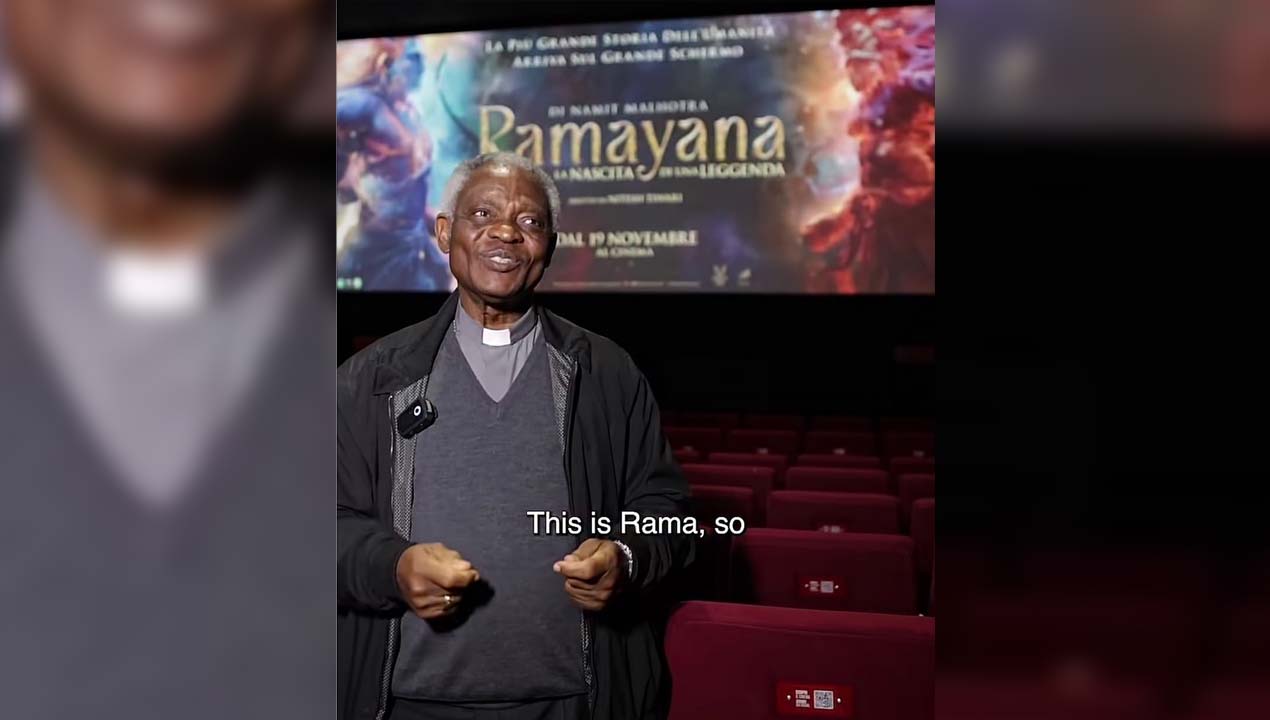
Vatican Cardinal Peter Kodwo Turkson Praises Universal Spiritual Values of Namit Malhotra’s ‘Ramayana’ at Special Rome Screening!
His Eminence Cardinal Peter Kodwo Turkson, Chancellor of the Pontifical Academy of Sciences, sees parallels between Ramayana, Ancient Near Eastern myths of Creation, Biblical Narratives and common themes of the supernatural, love, hatred, deceit, brotherly solidarity, etc., highlighting how India’s epic displays universal cultural and spiritual values.
Marking a historic milestone for Indian storytelling on the world stage, Namit Malhotra’s Ramayana has sparked global interfaith and cross-cultural dialogue following an exclusive screening in Rome. The special showcase was attended by Cardinal Peter Kodwo Turkson alongside members of the Pontifical Academy of Sciences, the Ambassador of Ghana to the Holy See and diplomatic staff, an architect, and invited guests, earning warm praise for the epic’s universal resonance.
The screening marks a meaningful moment in the sharing and communication of a story that is deeply rooted in Hindu faith and tradition with a Catholic audience and a wider interreligious and intercultural world.
With the film’s display of such themes as devotion, sacrifice, righteousness, compassion and the eternal triumph of good over evil, Ramayana has opened up a larger conversation around spiritual values that connect people across religions, cultures and civilizations.
Cardinal Turkson, a prominent figure in the Catholic Church from Ghana (Archbishop of Cape Coast), was elevated to the College of Cardinals in 2003 by Pope John Paul II. He has held several important positions in the Church, including serving as the President of the Pontifical Council of Justice and Peace under Pope Benedict XVI, and as the First Prefect of the Dicastery for Promoting Integral Human Development under Pope Francis. Currently, he serves as the Chancellor of the Pontifical Academies of Sciences and of Social Sciences. As such, his recognition of universal spiritual and ethical values in Ramayana’s presentation of the Indian epic recommends the movie highly to international interreligious and intercultural audiences.
Besides the Cardinal’s observation of how much killing the mythical line of the story brings up, he admired the masterly artistic presentation of such mythical themes as the creation of the world out of a conflict between deities or superhuman beings. He also appreciates greatly the film’s portrayal of the bond between Rama and Lakshman, Rama’s love for and commitment to Sita, the larger theme of love, fraternal solidarity and commitment.
Commending its music, visuals, sound effects and cinematic craftsmanship, he marvelled at how much technology, in its different forms, was involved in the production of the movie.
The conclusion of the first part, with the capture of Sita by deceit and by a supernatural evil one, the second part is expected to be a showdown between the evil one and Ram, the good and an equally supernaturally gifted, the rescue of Sita and triumphant return.
Clearly, the significance and the value of the film exceeds by far a simple movie experience. The film presents how basic human and spiritual virtues, in their coexistence with evil, as shown in Ramayana, find expression and resonance in the traditions of peoples. Ramayana’s ultimate value is the presentation on the coexistence and struggle between good and evil as not the definitive destiny of humanity, but the victory of good over evil. Though rooted in India’s epic and cultural consciousness, Ramayana speaks a universal language and initiates a global conversation on beliefs, traditions and humanity’s shared values.
https://www.instagram.com/reel/DgEouGSR3P3/?gwpx=MWt4YWJpazEzZjBudQ==
By Keerti Kadam