

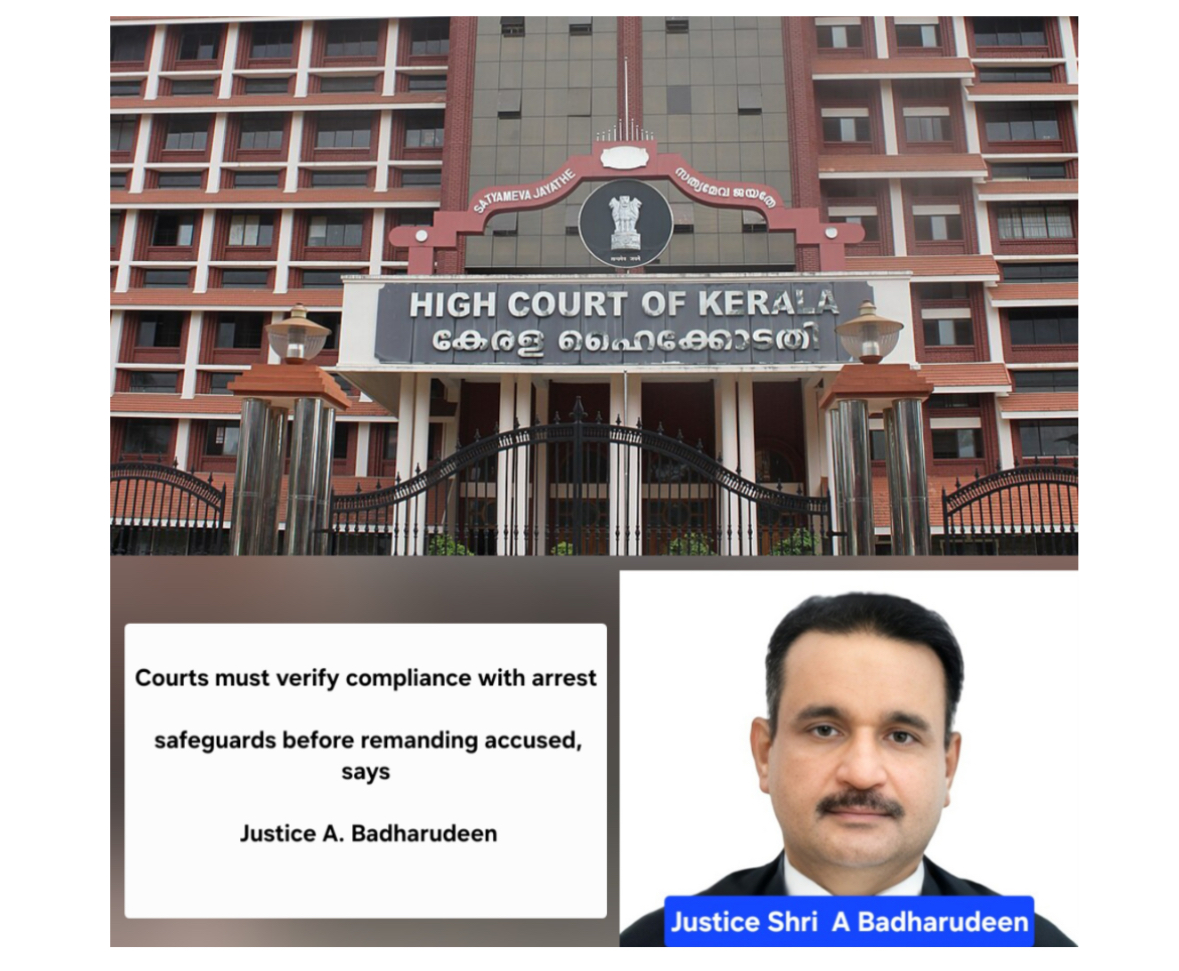
Illegal Arrest: Kerala High Court Says Accused Must Be Released Without Bail if Arrest Formalities Are Not Followed!
By Ronnie Rodrigues
Mumbai: Kerala High Court has directed all Criminal Courts in the District Judiciary to strictly verify compliance with the mandatory formalities of arrest before remanding an accused person to custody.
Justice #ABadharudeen, while dealing with a bail application in Jose M.P. v. State of Kerala, observed that repeated lapses in complying with arrest procedures had resulted in accused persons being released in several cases.
The Court made it clear that where an arrest is found to be illegal because the prescribed arrest formalities have not been complied with, the accused cannot simply be placed on bail. Instead, the person must be released from custody without requiring execution of a bail bond, as legally there is no valid arrest or custody.
The Court specifically directed Criminal Courts to ensure compliance with the required arrest formalities before passing any remand order.
Illegal arrest cannot be cured through bail
The High Court explained that once an arrest is found to be legally defective, the accused is effectively restored to the position that existed before the purported arrest.
In such circumstances, the Court held, granting bail does not arise, since bail presupposes a valid arrest and lawful custody.
The appropriate course for the Court, according to the judgment, is to set the accused at liberty without granting bail or requiring the execution of a bail bond.
The Court also clarified that such release would not prevent the investigating agency from arresting the person again. However, any subsequent arrest must be carried out only after completing all mandatory arrest formalities and strictly in accordance with law.
Courts directed to verify arrest formalities before remand
The High Court directed that if the required formalities cannot be completed within the time available before remand, the Court must release the accused forthwith, without granting bail and without insisting upon execution of a bail bond.
The release order should also specifically record that the release would not prevent the police from arresting the accused again after complying with the prescribed formalities.
The Court further directed that, where appropriate, permission may be granted to the Investigating Officer to arrest the released person again on the same day after completing the necessary legal formalities.
Prior notice and grounds of arrest
The Court particularly referred to lapses concerning the failure to issue prior notice where legally required and failure to furnish the grounds of arrest.
It reiterated that arrest is not merely a matter of taking a person into physical custody. The investigating agency must comply with the safeguards and procedural requirements governing arrest before seeking judicial remand.
The Court also referred to its earlier decision in Ashokan K.A. v. State of Kerala, reported in 2026 (2) KHC 523, in which directions had already been issued to Criminal Courts to ensure compliance with arrest formalities before remanding an accused.
Concern over continuing violations
The High Court expressed concern that despite earlier judicial directions, violations of arrest procedures were continuing on a significant scale.
It observed that some Investigating Officers were allegedly exploiting such procedural situations for ulterior purposes, resulting in accused persons being released due to non-compliance with mandatory requirements.
The Court therefore directed all Criminal Courts in the District Judiciary of Kerala to comply with the prescribed directions without fail.
The Registry was also directed to circulate the order to all Criminal Courts in the State and specifically instruct them to follow the directions contained in paragraph 8 of the judgment.
Bail application ultimately allowed
The directions were issued while allowing the bail application filed by the sole accused in a case registered by the Vigilance and Anti-Corruption Bureau, Idukki.
The prosecution alleged that the accused, an Assistant Executive Engineer with Thodupuzha Municipality, had demanded ₹1.50 lakh as illegal gratification for issuing a completion certificate and subsequently demanded and accepted ₹75,000 during a trap operation.
The Court noted that the accused had no criminal antecedents, had been in custody since July 27, 2026, and that the investigation had substantially progressed. It therefore found that his further custodial interrogation was not necessary and granted bail subject to conditions.
The judgment in Jose M.P. v. State of Kerala is reported as [2026:KER:69467].