

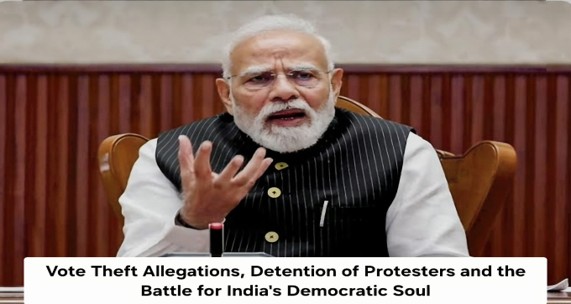
IS NARENDRA MODI: “THE ILLEGAL PRIME MINISTER OF INDIA”?
By Ronnie Rodrigues
Mumbai: When citizens begin questioning the integrity of elections and the freedom to protest, the government must answer with transparency, evidence and accountability—not silence or intimidation.
India calls itself the world’s largest democracy. But democracy is not measured merely by the number of voters, the frequency of elections or the size of a parliamentary majority. It is measured by whether every eligible citizen can vote freely, whether every vote is counted fairly, whether dissent is protected, and whether those exercising state power remain accountable to the Constitution.
The growing controversy over alleged irregularities in electoral rolls, demands for greater transparency from the Election Commission of India, and reports of protesters being detained have brought these fundamental questions into sharp focus.
The title “The Illegal Prime Minister” is a political challenge to Narendra Modi’s democratic legitimacy—not, by itself, a judicial finding that his appointment as Prime Minister is unlawful. The central question is whether the institutions underpinning India’s electoral democracy are operating with the transparency, independence and accountability that the Constitution demands.
1. Vote Theft: Are Voters Being Denied Their Democratic Voice?
Allegations of voter deletions, discrepancies in electoral rolls and irregularities in voter verification have fuelled public concern. Opposition leaders and activists have demanded explanations, while the Election Commission has defended electoral-roll revisions as necessary to remove duplicate and ineligible entries.
The controversy raises a question that should concern every Indian, regardless of political affiliation: can every eligible voter independently verify that their name remains on the electoral roll and that their democratic right is protected?
In October 2026, the Supreme Court issued notice on a petition concerning alleged irregularities in the Special Intensive Revision of electoral rolls and sought records relating to the Election Commission’s decision-making. These proceedings make transparency and independent scrutiny especially important. The allegations must be examined on the evidence, and affected voters must have an accessible process to challenge wrongful deletions.
An election can command public confidence only when the process is demonstrably fair, verifiable and open to lawful scrutiny.
2. Peaceful Protest and the Question of Illegal Detention
The right to question those in power is a cornerstone of democracy. Citizens must be able to assemble peacefully, express disagreement and demand answers without fear of arbitrary detention.
Recent protests over electoral-roll controversies have been accompanied by reports of mass detentions, restrictions on movement and disruptions to public services. Human rights organisations have criticised the handling of protesters, while authorities have cited public-order and security concerns.
The Supreme Court’s interventions concerning the Delhi protests have underscored the need to prevent illegal detention and protect lawful peaceful assembly, subject to legitimate public-order requirements.
The distinction is vital: maintaining public order is a lawful responsibility, but peaceful dissent cannot automatically be treated as a threat to the state. Where arrests or detentions occur, the authorities must demonstrate their legal basis and comply with constitutional safeguards.
A democracy must never confuse criticism of the government with hostility towards the country.
3. Is the Election Commission Independent Enough?
The Election Commission of India occupies a position of extraordinary public trust. Its credibility must rest not only on its constitutional status but also on demonstrable impartiality, transparent procedures and consistent enforcement of electoral rules.
When allegations arise concerning voter deletions or electoral irregularities, the appropriate response is to publish relevant records, explain the methodology, investigate credible complaints and provide effective remedies to affected voters. The Commission must be able to withstand scrutiny without political favour or fear.
Equally, allegations against it must be assessed on evidence rather than accepted merely because they are made by political opponents.
Electoral integrity cannot depend solely on the assurances of the institution responsible for administering elections. It must also be capable of independent verification.
4. Freedom of Speech, Journalism and Civil Dissent
A healthy democracy permits uncomfortable questions. Journalists must be able to investigate public-interest matters, citizens must be able to criticise public officials, and opposition parties must be able to challenge government policy.
Restrictions on speech, internet access, public gatherings and media activity require careful scrutiny. Any restriction must have a lawful basis, pursue a legitimate objective and be proportionate to the circumstances.
The government may disagree with its critics. It may rebut their claims and challenge falsehoods. What it must not do is allow the democratic space for peaceful disagreement to shrink beyond what the law permits.
5. Accountability Over Electoral Promises and Governance
Democratic legitimacy is sustained between elections as well as during them. Questions concerning employment, economic opportunity, inflation, public services, corruption allegations and the treatment of vulnerable communities deserve serious public examination.
These issues should not be reduced to slogans or partisan accusations. They should be evaluated against verifiable data, policy outcomes, official records and the government’s own commitments.
A government with a parliamentary majority is entitled to govern within the law. That majority does not exempt it from scrutiny, nor does electoral victory give any administration unlimited authority.
6. Constitutional Institutions Must Remain Above Political Interests
Parliament, the Election Commission, the judiciary, investigative agencies and the police all have distinct constitutional or statutory responsibilities. Public confidence weakens whenever credible questions arise about whether these institutions are acting independently and consistently with the law.
The answer is not to presume every allegation true. It is to ensure that complaints are investigated fairly, evidence is preserved, proceedings are transparent where legally appropriate, and those responsible for misconduct are held accountable.
The Constitution protects both the authority of the elected government and the rights of citizens. Neither can be allowed to erase the other.
7. The Opposition and the Responsibility to Prove Their Claims
The opposition has a legitimate role in scrutinising elections and challenging government conduct. But serious allegations—including claims of “vote theft”—must be supported by verifiable evidence.
Voter-level discrepancies, documented deletion errors, official records, court findings and independently audited data are more persuasive than viral posts or unverified claims circulated on social media.
The same standard must apply to the government. Dismissing concerns as political propaganda without addressing credible evidence is no substitute for a transparent response.
Democratic accountability requires evidence, consistency and equal standards for everyone.
8. Why the Title “The Illegal Prime Minister”?
The title is deliberately provocative. It asks whether democratic legitimacy can be sustained when serious questions about electoral transparency, institutional independence and civil liberties remain unresolved.
However, an important legal distinction must be maintained: Narendra Modi’s status as Prime Minister cannot accurately be described as legally invalid merely because allegations of electoral wrongdoing or voter-roll irregularities have been raised. Such a conclusion would require an appropriate legal basis and relevant judicial findings.
The stronger democratic argument is that no elected leader should be beyond scrutiny. The legitimacy of government is reinforced—not weakened—when allegations are investigated impartially, evidence is disclosed and institutions are seen to operate independently.
The title is therefore a demand for accountability, not a substitute for proof.
9. What Must Happen Now?
The following measures would help restore and strengthen public confidence:
– Electoral transparency: Publish clear, auditable information about voter additions, deletions and corrections, subject to lawful privacy safeguards.
– Effective voter remedies: Ensure that eligible citizens can promptly challenge wrongful deletion and verify their registration.
– Independent scrutiny: Investigate credible allegations of electoral malpractice through impartial and legally authorised mechanisms.
– Protection of peaceful protesters: Ensure that detentions have a lawful basis, procedural safeguards are respected and peaceful assembly is facilitated within reasonable legal limits.
– Accountability for misconduct: Investigate substantiated allegations of excessive force, unlawful restrictions or abuse of public office.
– Freedom of the press: Protect lawful reporting and ensure that restrictions on journalists are justified by law.
– Public answers: Require the relevant authorities to address documented concerns with evidence rather than rhetoric.
Conclusion: The Republic Belongs to Its Citizens
India’s democracy belongs neither to one political party nor to one individual. It belongs to the people whose votes confer political authority and whose constitutional rights place limits on that authority.
The allegations surrounding electoral rolls and the reported detention of protesters demand transparent answers, careful investigation and respect for constitutional freedoms. They should neither be dismissed without examination nor declared proven without evidence.
Narendra Modi and his government, like every elected government, must be judged by their adherence to constitutional principles, the integrity of the electoral process and their willingness to answer legitimate public questions.
The real test of leadership is not whether criticism can be silenced. It is whether a government can face scrutiny and still command public confidence.
No vote should be unlawfully denied. No peaceful citizen should be arbitrarily detained. No public institution should be beyond accountability. And no elected leader should be above the Constitution.
That is the democratic question behind the headline: “The Illegal Prime Minister.” Ultimately, the answer must come from evidence, constitutional principles and the lawful institutions of the Republic—not from a slogan alone.
10. Who Were the Men Seen Assaulting Protesters—and Why Were They Allowed to Act?
One of the most disturbing questions emerging from the recent Delhi protests concerns video footage showing men assaulting demonstrators, including a young woman. The protest organisers alleged that the men were associated with the BJP and RSS and questioned why the police appeared not to intervene to protect the protesters.
A report by Scroll, citing The Indian Express, said that four men seen in a viral video assaulting demonstrators were arrested. Their alleged political affiliations and the circumstances surrounding the incident must be established through a proper investigation.
But the larger question remains: when students and women take to the streets to exercise their democratic rights, who is responsible for protecting them from physical violence?
Were the individuals involved identified? Was the police response timely? Were the available videos examined? Were all those responsible, regardless of political affiliation, investigated under the law?
No political affiliation should provide immunity from investigation. If private individuals assault peaceful protesters, the authorities have a duty to protect victims, identify the perpetrators and pursue appropriate legal action.
The public deserves answers based on evidence, not political denials or counter-allegations.
11 . Missing Police Nameplates: Who Is Accountable for the Use of Force?
Another controversy concerns video footage showing Delhi Police personnel performing crowd-control duties without visibly identifiable nameplates.
Why were some officers’ nameplates missing? Were they removed deliberately, damaged during confrontations or detached accidentally? How can citizens identify the officers involved when they believe excessive or unlawful force has been used against them?
These questions are especially important when allegations of assault, intimidation or arbitrary detention arise.
In its reporting on the matter, The Indian Express described the Delhi Police’s explanation before the Supreme Court. The police stated that nameplates had been damaged or detached when personnel were allegedly manhandled during clashes. The police also disputed allegations of excessive force and described the violence they said officers had faced.
Those explanations must be considered alongside available footage, witness accounts, medical records and other evidence.
The objective should not be to presume every officer guilty. It should be to ensure that every officer exercising coercive state power remains identifiable and accountable in accordance with applicable rules.
If police personnel are empowered to detain citizens and use force, what effective mechanism allows an injured citizen to identify the officer responsible and seek redress? That question deserves a clear, documented answer.
12. The Silencing of the Public Voice: What Happened to Journalists and Protesters?
A democracy cannot function properly if citizens are unable to communicate, journalists cannot report freely and peaceful demonstrations are met with restrictions that are not adequately justified.
Recent reports from Delhi have raised concerns about journalists being detained while covering protests over electoral-roll revisions. The Indian Express reported that three of its journalists were briefly detained despite identifying themselves as members of the press.
The Associated Press also reported allegations by journalists and press-freedom groups that reporters covering the demonstrations had been detained or assaulted. Delhi Police, meanwhile, argued that some individuals had posed as journalists or interfered with police duties.
These competing accounts make an independent examination of the evidence essential. Were journalists detained solely because they were reporting events? Were press credentials checked? Were recordings deleted or access to protest sites restricted?
Were the restrictions lawful and proportionate?
The public also needs clarity about reports of communications restrictions and disruptions surrounding the demonstrations.
If the expression “Voice of the Nation being put on hold” refers to a particular news outlet, programme, website or social-media account, the exact incident and the authority responsible should be identified before publication. If it refers more broadly to the silencing of public dissent, the issue should be examined through documented instances of restrictions on journalists, protesters and communications.
Freedom of the press is not a privilege granted by those in power. It is an essential safeguard that enables citizens to scrutinise those who govern them.
13. Thousands Detained: Was Public Order Maintained at the Cost of Civil Liberties?
Coverage by The Indian Express of the October 2026 demonstrations described extensive police action against protesters demanding accountability over alleged electoral-roll irregularities. Its reporting referred to large-scale detentions, barricades and restrictions surrounding the demonstrations.
The scale of a police operation does not, by itself, establish that every detention was unlawful. Nor does the invocation of public order automatically justify every restriction imposed.
The proper questions are whether each detention had a lawful basis, whether the applicable safeguards were followed, whether detainees were informed of their rights and whether peaceful demonstrators were distinguished from individuals suspected of committing offences.
The Supreme Court’s scrutiny of the protests and the police response makes the production of reliable records particularly important.
Citizens deserve to know how many people were detained, how many were released, whether formal arrests were made, what legal provisions were invoked and whether complaints of mistreatment are being investigated.
Public order and civil liberty are not mutually exclusive. The rule of law requires the authorities to protect both.
14. The Fundamental Question: Can Electoral Integrity Be Independently Verified?
At the heart of these protests lies a dispute about electoral-roll revisions and allegations of irregularities. These allegations must be examined through verifiable voter records, transparent procedures and effective remedies for eligible citizens whose names may have been wrongly deleted.
The Election Commission and other relevant authorities should address specific, documented complaints with evidence. Political parties and protest organisers should likewise make their supporting material available for independent examination.
The integrity of an election should not depend on which party benefits from the outcome. It depends on whether eligible voters are treated fairly and whether the process commands public confidence.
Where errors are established, they must be corrected. Where allegations are not supported by evidence, that too should be stated clearly.
Democracy requires scrutiny that is rigorous, impartial and open to correction.
15. A Republic Must Answer Its Citizens
The allegations raised during these protests concern more than one party or one demonstration. They concern the relationship between the citizen and the state.
Who protects a student who is assaulted while protesting? Who investigates a complaint against a police officer? Who ensures that journalists can report without unlawful interference? Who provides a remedy to a voter whose name has been wrongly removed? And who independently verifies the conduct of institutions entrusted with safeguarding democracy?
These questions should be answered through transparent investigations, court-supervised processes where appropriate, credible public records and accountability under the law.
The headline “The Illegal Prime Minister” is intended to challenge the political establishment over these concerns. But the article’s lasting force must come from documented events and defensible arguments—not from treating contested allegations as established facts.
A democratic government must be prepared to answer difficult questions. Its institutions must be prepared to investigate uncomfortable allegations. And its citizens must remain free to demand accountability peacefully and lawfully.
The right to vote must be protected. The right to protest must be respected. The press must be free to report. And public power must remain accountable to the Constitution.