

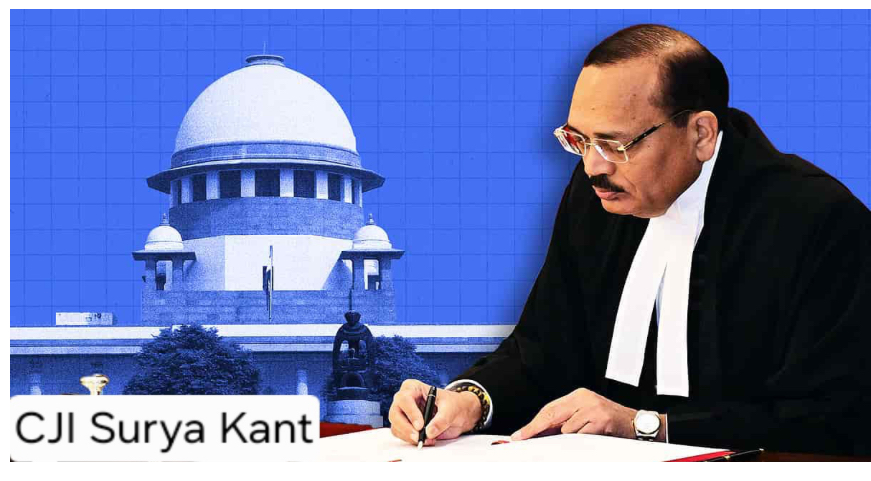
Modified Form 6 Not Approved by Supreme Court, CJI Surya Kant Clarifies!
By Ronnie Rodrigues
New Delhi: The Supreme Court on Monday clarified that it has not approved any modified version of Form 6 used for inclusion of names in electoral rolls during the ongoing Special Intensive Revision (SIR) exercise.
Chief Justice of India Justice Surya Kant, while hearing a petition seeking prosecution of Chief Election Commissioner Gyanesh Kumar and other officials, categorically stated that the Court had not approved the modified Form 6.
“Any modified Form 6 has not been approved by us. Let’s be clear. When the record is produced, we would like to see who has modified it,” the CJI observed.
The observation assumes significance as the Election Commission of India (ECI) had, in a press release issued on September 26, indicated that the new declaration annexed to the online Form 6 being used during the SIR exercise in certain States had been approved by the Supreme Court.
Supreme Court Had Not Examined New Declaration
The controversy concerns changes introduced in the declaration accompanying the new Form 6. The issue arose after it was reported that two Election Commissioners had raised objections to the changes, reportedly on the ground that such modifications could not be introduced without an amendment to the Registration of Electors Rules, 1960.
The controversy intensified following reports that the modified declaration was implemented despite those objections.
The ECI subsequently stated that the declaration had been upheld by the Supreme Court in its May 2026 judgment concerning the Bihar SIR.
However, the new declaration was introduced after the Supreme Court’s judgment in the Bihar SIR matter. Consequently, the modified Form 6 declaration had not been before the Court for consideration in that case.
The CJI’s observation on Monday appeared to put the issue beyond ambiguity, making it clear that the Supreme Court had not approved the modified Form 6.
Concern Raised Over Delhi SIR
The issue of the modified Form 6 was raised before the Bench in the context of the ongoing SIR exercise in Delhi.
Senior Advocate Menaka Guruswamy, appearing in the matter, drew the Court’s attention to the use of the new declaration and raised concerns regarding the manner in which the changes had been introduced.
Under the modified declaration, a person seeking registration as a new voter is required to state whether the person or his or her parents had been mapped in the previous SIR exercise.
Such a requirement was not contained in the earlier Form 6 used during the SIR exercises in other States.
Notice Issued on Plea Challenging ECI Decisions
The Bench comprising Chief Justice of India Justice Surya Kant, Justice Joymalya Bagchi and Justice V. Mohana was hearing a writ petition filed by Advocate Shailendra Mani Tripathi, challenging 14 decisions allegedly taken unilaterally by the Election Commission and its officials.
The petitioner has sought the quashing of the decisions and has also sought the constitution of an independent Judicial Inquiry Commission/Special Investigation Team, headed by a retired Supreme Court judge and assisted by cybersecurity and information-technology experts.
The petition further seeks directions to the competent authority to register complaints and initiate prosecution under Section 32 of the Representation of the People Act, 1950, against Chief Election Commissioner Gyanesh Kumar, Senior Deputy Election Commissioner Maneesh Garg, Director General (IT) Seema Khanna and other officials who may be found responsible for the alleged breach of official duties.
Section 32 of the Representation of the People Act provides for punishment in respect of specified breaches of official duty relating to the preparation, revision or correction of electoral rolls.
Court Questions Scope of Prayers
During the hearing, the CJI also observed that the prayers contained in the petition appeared to be “omnibus” and “jumbled up.”
Senior Advocate Menaka Guruswamy, however, maintained that she stood by the prayers made in the petition.
After hearing the submissions, the Bench issued notice on the petition and directed that the matter be tagged with a similar pending case challenging the decisions of the Election Commission.
The Supreme Court’s clarification regarding the modified Form 6 is likely to assume importance in the ongoing debate over the legal authority and procedural basis for changes introduced during the Special Intensive Revision of electoral rolls.